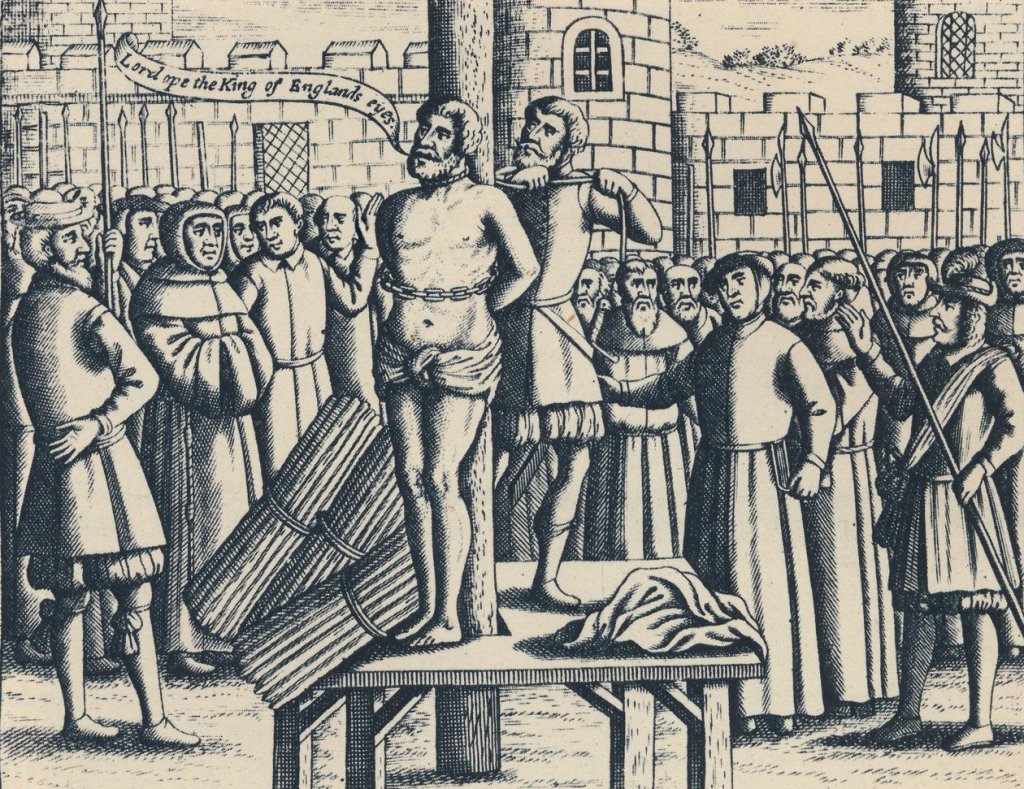
489 years ago today, on October 6, 1536, in the small Flemish town of Vilvoorde, a man was led from his prison cell to a wooden stake where he was strangled and burned. His crime? Translating the Word of God into English.
William Tyndale was born around 1494 in Gloucestershire, England, and studied at Oxford and Cambridge. There, his soul caught fire with one conviction: every plowboy in England should have access to the Word of God. In fact, Tyndale’s conviction on this was so strong that when a clergyman once told him that it would be better to be without God’s law than the pope’s, Tyndale replied:
“I defy the Pope and all his laws. If God spare my life, ere many years, I will cause the boy that driveth the plow to know more of the Scripture than thou dost.”
Denied permission to translate Scripture in England, Tyndale fled to continental Europe. In 1525, his English New Testament, translated directly from the Greek, was printed in Germany and smuggled into England in barrels and bales of cloth. The authorities burned every copy they could find, but they could not stop the spread of the Word.
Over the next decade, while in exile, Tyndale revised his New Testament and translated much of the Old Testament, including Genesis through Deuteronomy and parts of Joshua and Chronicles. However, in 1535, he was betrayed by a false friend, Henry Phillips, and was arrested near Brussels, where he was imprisoned for over a year. Even in confinement, he continued to study and write. When the sentence of death was pronounced, he stood firm.
At the stake, before the strangler’s cord tightened, he cried out:
“Lord, open the King of England’s eyes.”
And God answered that prayer. While the Lord did not radically save Henry VIII, He opened the King’s eyes, causing him to use his power to advance the Word rather than suppress it. Only three years later, Henry VIII authorized the publication of the Great Bible, the first English Bible to be placed in every parish church in England, a translation based mainly on Tyndale’s work. Even the plowboy could now read the Word.
The Meaning of Tyndale’s Prayer
Tyndale’s dying words reveal more than frustration or bitterness. They display a profound theology of God’s sovereignty, illumination, and the unstoppable advance of Christ’s Kingdom.
1. He Believed in the Power of the Word
Tyndale’s great burden was not for his own name, but for the Word of God to run free. He was convinced that Scripture is the ordinary means by which the Holy Spirit opens spiritual eyes. His final prayer was not for release, but for the Word’s triumph.
2. He Believed in God’s Sovereignty over Kings
Rather than curse Henry VIII, Tyndale prayed for him. He understood that the hearts of rulers are streams in the hands of God (Prov 21:1). His prayer was an act of faith in the Lord who governs nations, reforms churches, and bends empires to accomplish His perfect will.
3. He Believed That the Kingdom of Christ Would Prevail
In Tyndale’s day, it seemed impossible that England would ever have a Bible in her own tongue. But faith sees beyond impossibility. His prayer looked past the flames to the future, to a day when even the plowboys would know God’s Word in their heart language.
Lessons for the Church Today
The church of our generation stands in the long shadow of William Tyndale’s pyre. His example calls us to courage, conviction, and confidence in the Word of God. And we can learn a few lessons today:
1. We Must Treasure the Word
Tyndale gave his life so we could hold a Bible in our own language. Yet in our day, Bibles gather dust while screens glow bright. The Word that cost him everything often costs us nothing. Let us return to a reverent, joyful knowledge of Scripture by reading, meditating on, and obeying it as the voice of the living God. Part of this lesson is that God’s Word must not only be available but also obeyed. We do not honor Tyndale’s memory merely by possessing many Bibles. We honor him by being people of the Book. We are to be people who read, teach, and apply the truth of the Bible in every sphere of life.
2. We Must Proclaim the Word
Tyndale’s work was evangelistic to its core. He wanted every man, woman, and child to hear the gospel clearly. The church must recover this passion, not for clever phrases or cultural applause, but for clarity of truth. We need men and women who will speak the Word plainly, even when it offends.
3. We Must Pray for the Powerful
Tyndale’s final prayer was not for revenge, but for repentance. “Lord, open the King of England’s eyes.” We should pray that kings, presidents, and magistrates would see the truth of Christ and govern under His lordship.
4. We Must Endure for the Long View
Tyndale never saw the fruit of his labor. The Great Bible, the Reformation in England, and eventually the King James Version all came after his death. Faithfulness sometimes means sowing seeds whose harvest you will not live to see. The Word of God is not bound; our calling is simply to obey and trust God with the fruit.
Conclusion
The story of Tyndale’s life is not just history. It is a testimony to the power of the Word of God and the courage of those who love it. The Reformation was not simply a theological debate. It was a war over authority: Who speaks for God? The church of Tyndale’s day claimed that only the clergy could rightly handle Scripture. Tyndale declared that the Bible itself speaks with divine authority, and that every Christian has the right and responsibility to hear and obey it. That conviction cost him his life, but it also changed the world.
Five centuries later, the prayer of a dying translator still echoes:
“Lord, open the King of England’s eyes.”
It was a plea for illumination, for the Word to govern hearts, homes, and thrones.
And God answered according to His will. May He answer again in our day. May He open the eyes of our leaders to truth. May He open the eyes of His church to obedience. May He open the eyes of our nation to Christ. And may He open our own eyes, to see that the same Word still speaks with living power, calling us to repentance, courage, and joy in the King who reigns forever.
“The Word of God is not bound.”
— 2 Timothy 2:9

 Colt Hudson