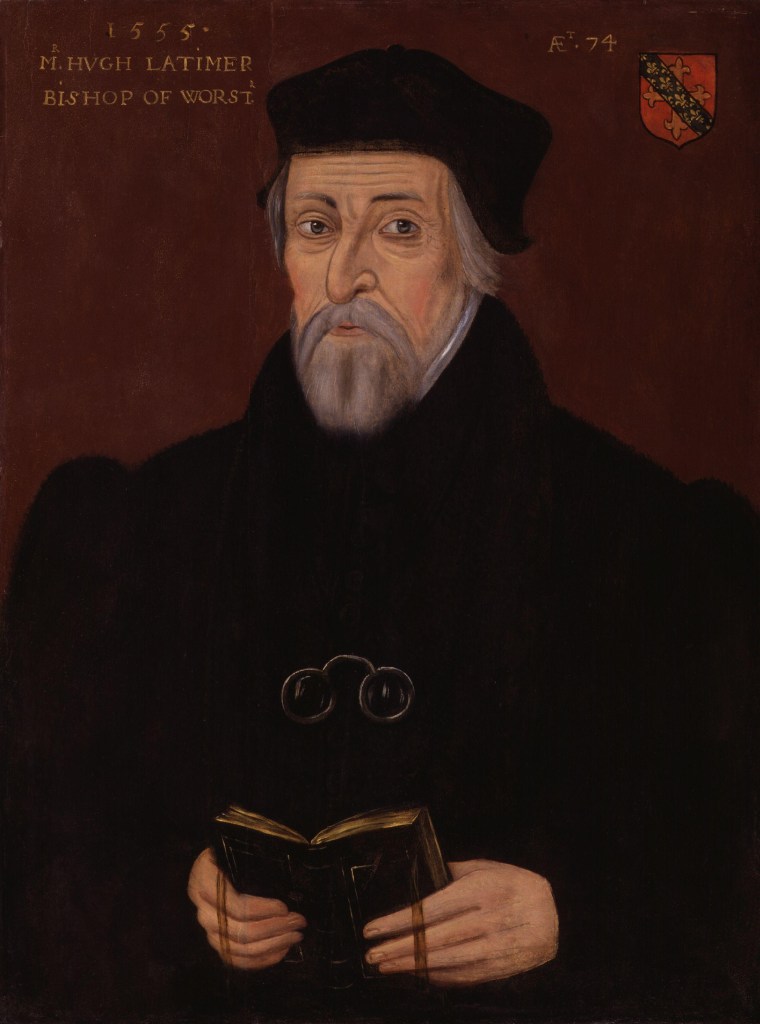
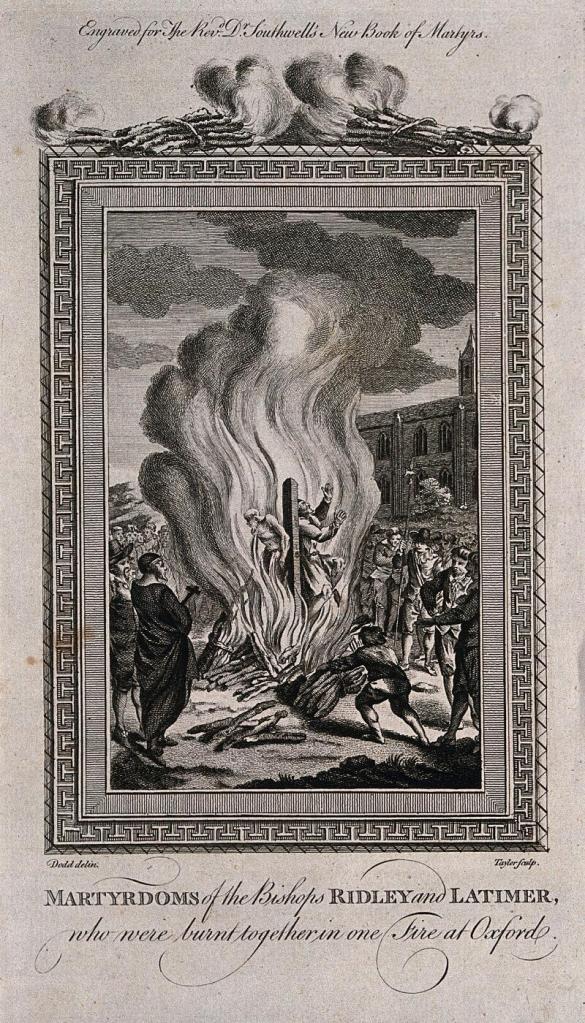
467 years ago, this week, the Oxford Martyrs were burned at the stake for standing on the Reformation principles of the Gospel. Hugh Latimer and Nicholas Ridley were burned at the stake on October 16, 1555 outside of Balliol College in Oxford. That day, Hugh Latimer produced one of the most famous quotes of the Reformation. As the executioners lit the fires, Latimer turned to Ridley and said:
“Be of good comfort, Dr. Ridley, and play the man. We shall this day light such a candle by God’s grace in England, as I trust never shall be put out.”
Though Latimer’s quote is, in my opinion, one of the greatest expressions of boldness and trust in God’s providential care, it is not for this reason alone that he should be remembered with fondness by believers. It was not Latimer’s final quote but the totality of his faithfulness to the Gospel of Christ that makes him a hero of mine. His portrait hangs on the wall of my office to remind me that faithfulness to God’s Word alone must motivate my every action. Latimer’s commitment to the Gospel began in his conversion, was evidenced in his preaching, and was confirmed in his death.
Latimer was born into a family of simple farmers but rose to attend the University of Cambridge, where he served as the university preacher and chaplain. Throughout this time, Latimer was an ardent Catholic who hated the teachings of the Reformation. He described himself as “obstinate a papist as any was in England.” However, much like Paul, the persecutor of the Reformation soon became a preacher of the Reformation. God, in His Providence, used another former Catholic to lead Latimer to the Gospel.
Thomas Bilney had come to faith in Christ and sought to share the true Gospel with Latimer in a creative way. Bilney asked Latimer to hear his confession, but rather than a confession, Bilney shared the pain that he had felt from the depths of his sin and how he had found peace through salvation by grace through faith. Latimer was awestruck and instantly, he believed the Gospel. Latimer stated, “I learnt more by this confession than by much reading and in many years before. I now tasted the word of God, and forsook the doctors of the school and all their fooleries.” Though Latimer heard Bilney’s “confession,” it was he who confessed, repented, and believed the Gospel.
From that day onward, Latimer was immovably committed to preaching and defending the true Gospel. This was evident in his preaching and teaching as the Bishop of Worcester. Perhaps the best example of Latimer’s faithfulness came in his sermons before King Henry VIII. Latimer once preached with particular boldness and conviction on the biblical teaching against divorce while Henry VIII was in the congregation. Henry was obviously unhappy with the content of the sermon and ordered Latimer to apologize the following week and take back his teaching. The following Sunday, with Henry VIII in the congregation looking for an apology, Latimer began his sermon with the following prayer:
“Latimer! Latimer! Do you remember that you are speaking before the high and mighty King Henry VIII; who has power to command you to be sent to prison, and who can have your head cut off, if it please him? Will you not take care to say nothing that will offend royal ears?” He then paused and continued, “Latimer! Latimer! Do you not remember that you are speaking before the King of Kings and Lord of Lords; before Him, at whose throne Henry VIII will stand; before Him, to whom one day you will have to give account yourself? Latimer! Latimer! Be faithful to your Master, and declare all of God’s Word.”
Latimer faithfully lived out Matthew 10:28, “And do not fear those who kill the body but cannot kill the soul. Rather fear him who can destroy both soul and body in hell.” He exemplified Paul’s exhortation to Timothy to preach the word whether in season or out of season. Latimer defied a King that beheaded multiple wives and instead remained faithful to God alone. In the current day, in which it is all too common for the church and churchmen to capitulate to the culture by compromising God’s Word, we need more men like Latimer. Men who will faithfully stand on the Word even when it costs something. Far too many will not share the Gospel with a friend for fear of awkwardness, much less boldly preach the Word to tyrants.
Latimer’s commitment to God’s Word continued to his final moments. Latimer persevered to the end; he was faithful to God’s Word even when it ultimately cost him his life. When Henry’s daughter ascended to the throne, she earned the nickname “Bloody Mary” for her ruthless persecution of protestants, ordering the death of around 300 people. Because Latimer and his colleagues, Nicholas Ridley and Archbishop Thomas Cranmer, would not repent of their convictions, they were sentenced to be burned at the stake immediately. As Ridley and Latimer were chained to the stake and the kindling lit, Latimer offered his famous words. These words evidence Latimer’s faith in God’s Providence and the sureness of his salvation. “Be of good comfort” or “good cheer.” How can one say such a thing amidst being burned? The comfort of the Gospel and the knowledge that “to die is gain” allowed them to be cheerful even while facing such a painful death. Latimer’s encouragement to “play the man” showed that his desire was to be bold in the face of persecution and to demonstrate courage and faith. Finally, Latimer’s assurance that they were lighting a candle by God’s grace in England evidenced his firm belief in God’s providence. Latimer knew that they were not dying in vain, but rather their death would be an example and encouragement to others to stand firm in the faith. Though Latimer did not know how God would use their death, he knew that God would use it to accomplish His purposes for the Gospel in England.
As amazing as the “play the man” quote is, I am often baffled by an earlier quote. At Latimer’s sentencing, he rejoiced saying, “I thank God most heartily that He hath prolonged my life to this end, that I may in this case glorify God by that kind of death.” He saw even his death as an opportunity to glorify God. Again, we see that Latimer exemplifies the words of Romans 8:18, “For I consider that the sufferings of this present time are not worth comparing with the glory that is to be revealed to us.”
Today, may we all “play the man.” We do this not by simply putting on a brave façade of macho-ness. But rather, we “play the man” by seeking to glorify God in whatever He has called us to, whether that be preaching boldly without compromising before kings or dying a martyr. May we be inspired by Latimer’s legacy of standing on the Word regardless of what it may cost.

 Colt Hudson