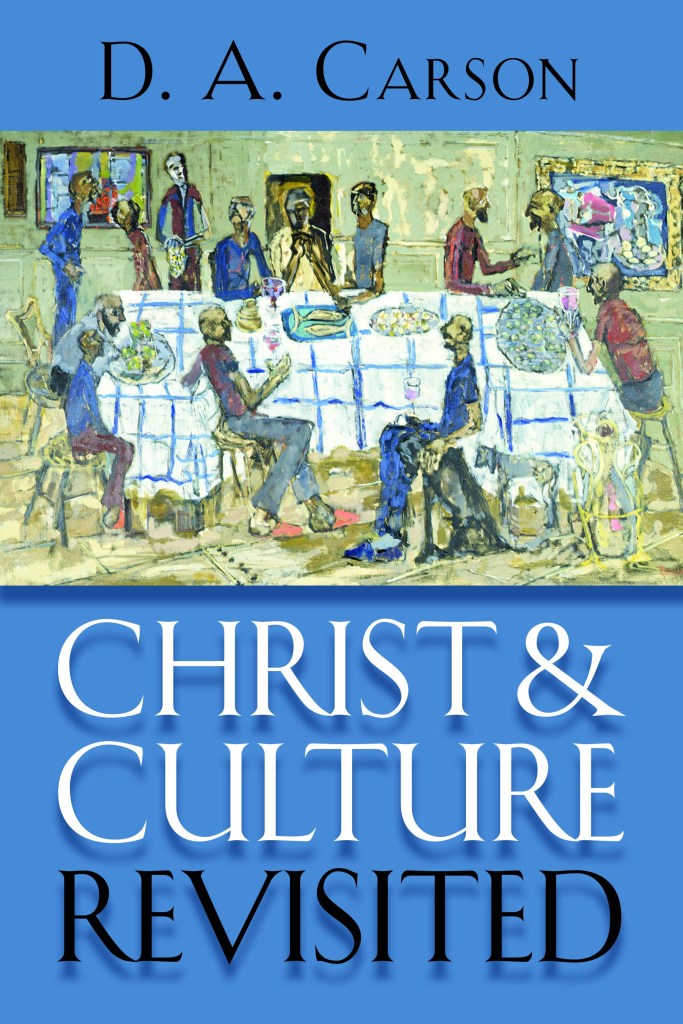
In my recent Ph.D. Seminar on Cultural Anthropology, I was required to read a book called Christ and Culture Revisited by D.A. Carson. Carson is a well-known author and is probably most known for founding The Gospel Coalition. This book’s major thrust was that the relationship between Christians, Christ, and Culture is complex. In today’s world, in which so much cultural chaos and disorder exists, Christians are frequently asking, “how should my faith interact with culture?” To answer that question, I would like to share some of the concepts that I picked up from my reading of The Bible and Carson’s work.
How do Christians navigate culture biblically?
1.We must remember to Whom this world belongs.
For Christians, it is vitally important to never lose sight of the fact that God created all things. Upon God’s creation of the universe, we are told from the Bible that God pronounces creation as “Good.” Yet, the world we live in has been corrupted by the sin of mankind. This creates a kind of tension that has impact on how we live. We must remember that it is God who owns this world. Even though the world is fallen, it is still God’s world.
“Christians cannot long think about Christ and culture without reflecting on the fact that this is God’s world, but that this side of the fall this world is simultaneously resplendent with glory and awash in shame, and that every expression of human culture simultaneously discloses that we were made in God’s image and shows itself to be mis-shaped and corroded by human rebellion against God,” Carson said. (page 49)
The Bible is clear that everything exists to bring glory to God. Thus, we must remember that, as created things, we fall into the category of things that exist to bring glory to God. So, whenever we interact with culture, or do anything for that matter, we must do it unto the glory of God. If “even the rocks cry out” as the Bible says, then we too should cry out, declaring God’s goodness in all things. At the same time, this world is fallen and in need of redemption. The world shows itself to be corrupted by sin and, as such, we should expect hostility from culture that is saturated and shaped by rebellion.
1 Peter 4:12-13 says as much: “Beloved, do not be surprised at the fiery trial when it comes upon you to test you, as though something strange were happening to you. But rejoice insofar as you share Christ’s sufferings, that you may also rejoice and be glad when his glory is revealed.” As Christians we should not be surprised that by living for the glory of God, the culture will attempt to cause us suffering. Christ warned us of such things when He said, “If the world hates you, know that it has hated me before it hated you.” (John 15:18 ESV) However, when we suffer for Christ, we bring Him glory. Shortly, there will be a day in which His full glory is revealed upon His return and every knee will bow and tongue confess that He is Lord. Remember, this is our Father’s world.
2.We must remember that our hope is in Him.
It is important to remember that our hope is in Him. This is likely not a new thought for many believers. Yet, though people will quickly confess this truth, they are equally quick to supplement (or supplant) their hope in Christ with hope in the political and cultural systems of this world. Systems which we have already established to be fallen and corrupted by sin. If we are to be thoroughly and consistently biblical, as we should, we must place our hope in Christ alone.
Carson states, “Yet while Christians, knowing that this is a fallen and broken world, not only concede such freedom but applaud it, they also know that in the consummation of the Kingdom there will be no dissent of the governed: we will have our minds and hearts perfectly attuned to the will and pleasure of our Maker and Redeemer. Our ultimate hope, therefore, can never rest in the freedoms that democracy seeks to institutionalize. Such freedoms are at best stopgap measures to mitigate evil in a rebellious world. As such they deserve the support and nurture of Christians and non-Christians alike. But that is a far cry from giving them the sort of ultimacy often assigned them.” (page 136)
The fundamental truth of humanity’s systems of government is that they will never be perfect because they are sinful systems devised by sinful people. Where governments and politics are in line with biblical truth, we should support them. Where government and politics diverge from or contradict biblical truth, we condemn them. Either way, the lens through which we view government, as with all things, is biblical truth. That truth reminds us that in God’s kingdom there will be ultimate perfection and perfect alignment with the King of Kings. Therein lies the hope of Christians. We are not of this world, and our hope must not be either.
3.We must remember that we have a responsibility to live Biblically and share Biblical truth with others.
Finally, we must remember that the Bible calls us to live as a people that are set apart. The Bible goes so far as to say “But you are a chosen generation, a royal priesthood, a holy nation, His own special people, that you may proclaim the praises of Him who called you out of darkness into His marvelous light.” (1 Peter 2:9 ESV) The King James version describes the people in 1 Peter as a “peculiar people.”
The point is that we are called, as believers, to a different life, a life governed by the Bible. Carson agrees, “These biblical realities make for a worldview that is sharply distinguishable from the worldviews around us, even where there are overlapping values. We cannot embrace unrestrained secularism; democracy is not God; freedom can be another word for rebellion; the lust for power, as universal as it is, must be viewed with more than a little suspicion. This means that Christian communities honestly seeking to live under the Word of God will inevitably generate cultures that, to say the least, will in some sense counter or confront the values of the dominant culture. But to say the least is not enough. Christians thus shaped by Scripture envision a church that not only counters alternative cultures but also seeks sacrificially to serve the good of others – the city, the nation, common humanity, not least the poor. Salt does not confront; it enhances. Believers must be the best possible citizens (cf. Jeremiah 29:7; cf. also 1 Peter 1:1; James 1:1), and that means that Christians, who are taking their cue (and thus their worldview) from outside the dominant culture, not only shape and form a Christian culture recognizably different from that in which it is embedded but also become deeply committed to enhancing the whole.” (pages 143-144) To summarize Carson’s point, Christians live differently from dominant culture because of our faithfulness to biblical commands and we are to seek to enhance culture and sacrificially serve others by following the mandates and example of Christ. We are to be different. We are not to be isolationists. Rather, we are to influence culture to the glory of God by sharing His Word, the Gospel, with those around us. We are to model Christlikeness to the culture around us. We do this by understanding the world around us in relation to its Creator, by placing our hope in God alone, and by living biblically. If Christians will be faithful to do this, we will doubtless impact our culture

 Colt Hudson